GoHighLevel Automation: What It Is and When to Bring in a Consultant
GoHighLevel can automate lead follow-up, booking, and client communication. Here's how to tell if you should build it yourself or hire a consultant.
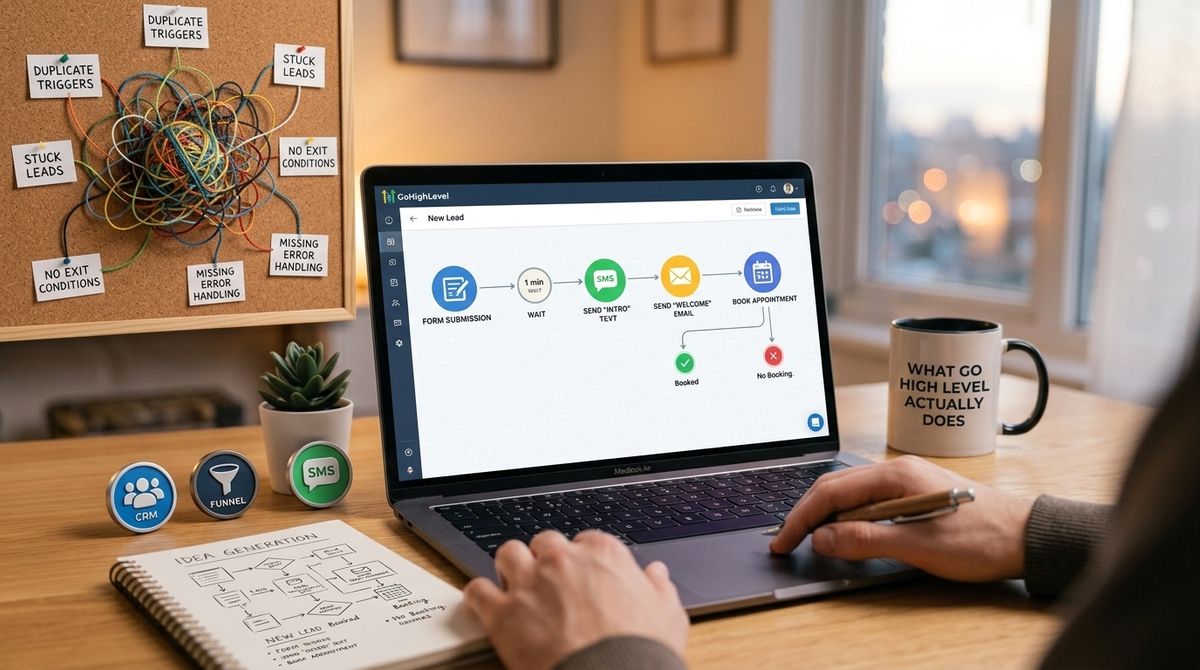
What GoHighLevel actually does
GoHighLevel is an all-in-one platform that combines CRM, email, and SMS marketing, appointment scheduling, funnel and website building, and automation workflows into a single system. It was built with agencies and service-based businesses in mind, which is why it has become popular among marketing consultants, contractors, salons, gyms, and law firms who need a single tool to replace five or six separate subscriptions.
The core value isn't any single feature. It's that a lead can fill out a form, get texted within a minute, land on a calendar, receive a reminder, and then get a review request after the appointment, all without a person touching it. That's the automation piece, and it's where most of the platform's real value lives.
How the automation piece works
GoHighLevel automations are built around triggers and workflows. A trigger is an event, like a form submission, a missed call, or a tag being added to a contact. A workflow is the sequence of actions that happen after the trigger fires: send an email, wait two days, send a text, check whether they booked, and branch to a different path if they didn't.
On paper, this sounds simple. In practice, a workflow with more than a few branches gets complicated fast. Businesses often end up with workflows that overlap, contacts that get tagged twice and enter the same sequence from two directions, or automations that quietly stop firing because a trigger condition was set up wrong months ago.
Where DIY setups tend to break down
Most businesses can handle a basic lead capture form and a simple follow-up sequence on their own. The trouble starts when the business tries to scale that logic across multiple services, locations, or lead sources without a clear underlying structure.
- Duplicate or conflicting triggers that send the same contact into two workflows at once
- Workflows have no exit condition, so contacts stay stuck in a sequence forever.
- Missing error handling, so a failed step (a bad phone number, an expired API key) breaks the whole chain silently
- Calendars, pipelines, and automations that were built separately and never fully connected
- No documentation, so if the person who built it leaves, nobody understands how it works.s
None of these is a dramatic failure. They're the kind of small, quiet issues that cost a business leads and follow-up over months without anyone noticing until someone asks why response times have slipped.
When it's fine to build it yourself
If a business has one or two services, a modest lead volume, and a straightforward follow-up sequence (new lead gets a text, then an email, then a call reminder), building it in-house is reasonable. GoHighLevel's templates and community resources cover most of that ground, and the learning curve is manageable for someone willing to invest a few hours a week.
When it's worth hiring a consultant
The calculation changes once the business has multiple lead sources feeding into different pipelines, needs the CRM to talk to outside tools through an API, or is migrating years of contact data and automation logic from another system without losing anything. At that point, the cost of getting it wrong (missed leads, duplicate messages to customers, broken integrations) is usually higher than the cost of paying someone to build it correctly the first time.
It's also worth bringing in outside help when the business has tried to build it internally, and the system has become something nobody fully trusts. That's a common pattern: workflows get added on top of workflows until the logic is tangled enough that even the person who built it isn't sure what fires when.
The point of automation is to remove manual work, not to create a system that requires more manual oversight than the process it replaced.
What a good engagement should look like
A consultant worth hiring should start by auditing what already exists rather than rebuilding from scratch by default. Some workflows are fine and need cleanup. Others need to be torn down and rebuilt with clear triggers, defined exit points, and built-in error handling from the start.
The engagement should end with the client owning the system, not depending on the consultant to fix every small change. That means documentation of how each workflow works, a walkthrough with whoever manages the CRM day-to-day, and a scope that was fixed and clear from the outset, rather than an open-ended retainer.
Resilio Partners approaches this kind of work the way it approaches any custom build: fixed-price, scoped to a specific outcome, and judged by whether the automation actually reduces manual work rather than just looking impressive in a demo. For a business trying to decide whether to fix a GoHighLevel setup internally or bring in outside help, that's the right question to ask any consultant: what breaks, and what gets faster, once this is done.