How to Scope an MVP Without Building More Than You Need
Learn how to scope an MVP that tests your core idea without wasting budget on features customers may never use.
How to Scope an MVP Without Building a Whole Product First
Figuring out how to scope an MVP is where most software projects go wrong before a single line of code gets written. Founders start with a good idea, then a wish list of features attaches itself to that idea until the project has doubled in cost and timeline before anyone has tested whether customers even want it.
An MVP, or minimum viable product, is supposed to answer one question: Does this solve a real problem well enough that people will use it or pay for it? The word "minimum" gets lost fast.
What Does MVP Actually Mean for a Small Business?
For a small or mid-sized business, an MVP is not a stripped-down version of your final vision. It is a working tool built around one core workflow, released to real users, and measured against real behavior.
That distinction matters because it changes how you plan. You are not building 20% of a big product. You are building 100% of a small, useful one. Everything else waits until you have evidence that it is worth building.
How to Scope an MVP: Start With the Problem, Not the Feature List
The biggest mistake in scoping happens before anyone opens a feature spreadsheet. Teams jump to what the product should do instead of naming the specific problem it needs to solve for a specific user.
Write down the one workflow or decision your MVP needs to support. If you can't describe it in a sentence or two, the scope is already too broad. Every feature you add after that should trace back directly to that sentence, or it doesn't belong in version one.
Signs Your MVP Scope Is Turning Into a Full Product
Scope creep on an MVP rarely arrives all at once. It shows up as small, reasonable-sounding additions that each make sense on their own but add up to a much bigger build.
- You're designing for edge cases before you've validated the main case.
- The feature list includes admin dashboards, reporting, or analytics that no one has asked for yet.
- You're building for a user scale you don't have yet.
- "While we're at it" has become a regular phrase in planning meetings.
- The launch date keeps getting pushed back because something new keeps getting added.
How Many Features Should an MVP Have?
There's no fixed number, but a useful test is this: could you remove any single feature and still have something worth putting in front of a user? If the answer is yes, that feature probably doesn't belong in the first version.
Most MVPs that ship successfully do one thing well. Login is one core action and a way to see the result of that action. Payments, integrations, permission tiers, and customization options usually belong in a later phase, not the first.
A Simple Framework for Scoping an MVP
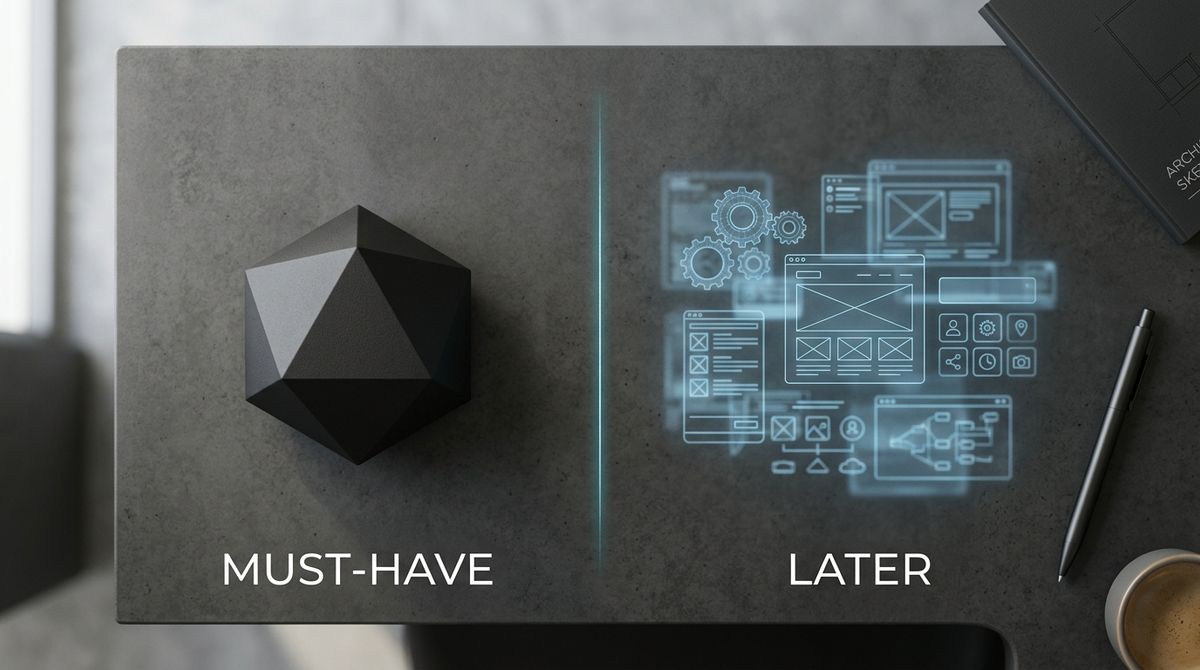
A workable way to scope an MVP without overbuilding is to sort every proposed feature into three buckets before development starts.
- Must-have: the product breaks or the core problem goes unsolved without it.
- Nice-to-have: improves the experience but isn't required to test the concept.
- Later: valuable eventually, but only makes sense once you have real usage data.
Only the first bucket makes it into the MVP. The second and third buckets get documented, not discarded, so the roadmap for what comes next is already in place once the MVP proves itself.
An MVP isn't the smallest version of your product. It's the smallest version of the truth about whether your idea works.
How to Scope an MVP When You're Ready to Build
Once you know how to scope an MVP around a single problem and a short must-have list, the build itself gets faster, cheaper, and easier to evaluate, honestly. You'll know within weeks, not quarters, whether the idea holds up with real users.
At Resilio Partners, this is the first conversation we have with a client before any contract is signed: what is the smallest version of this that tells us something true? Fixed-price, project-based work only makes sense if the scope is tight enough to know what "done" looks like from day one.
Frequently Asked Questions
What is an MVP, actually? An MVP, or minimum viable product, is a working version of a product built around a single core workflow and released to real users to test whether it solves a real problem well enough that people will use it or pay for it. It's not a smaller version of the final product. It's a complete, functional answer to one specific question.
How many features should an MVP have? There's no fixed number. A useful test is whether you could remove any single feature and still have something worth putting in front of a user. If yes, it probably doesn't belong in version one. Most successful MVPs do one thing well: a way in, one core action, and a way to see the result of that action.
What's the difference between an MVP and a prototype? A prototype demonstrates an idea, often without real functionality, and is typically used internally or with a small group to gather feedback before building anything real. An MVP is a fully working product released to actual users, built to generate real usage data and real evidence about whether the idea holds up.
How do I know if my MVP scope is too big? Common signs include designing for edge cases before the main case is validated, adding admin dashboards or analytics no one has asked for, building for a scale of users you don't have yet, and a launch date that keeps slipping because something new keeps getting added to the list. If a feature doesn't trace directly back to the one core problem the MVP is meant to solve, it belongs in a later phase, not the first.