What SAM.gov Registration Means for Government Contracting
SAM.gov registration is the first legal requirement for government contracting, and one wrong detail can delay your first contract by months.
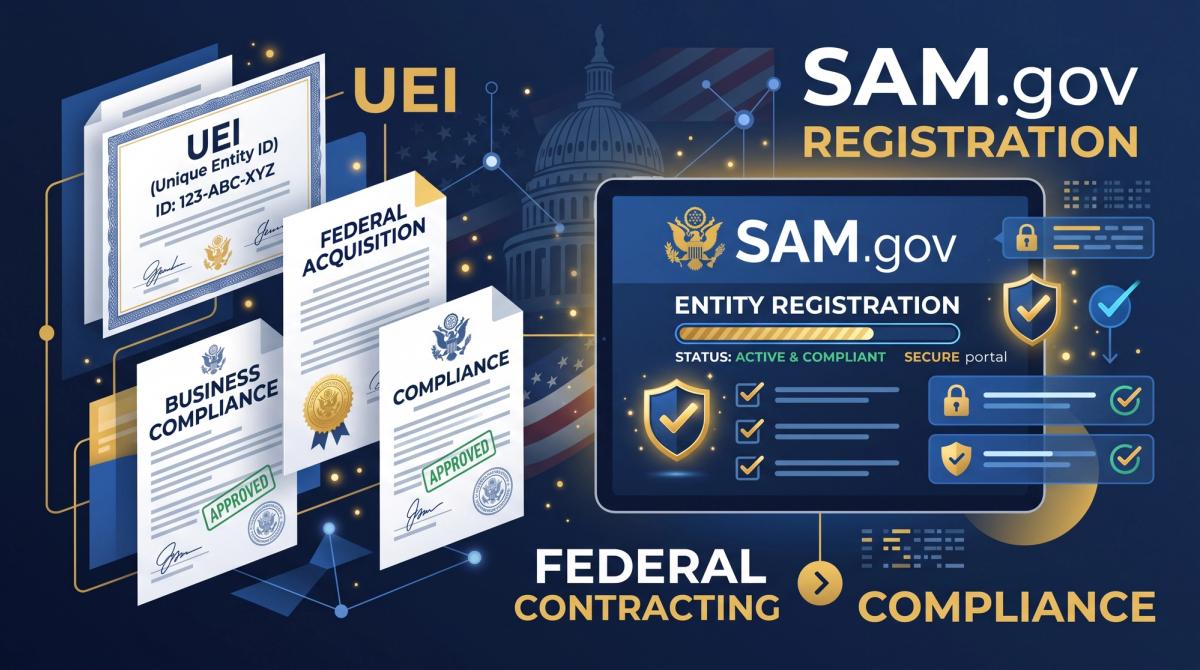
SAM.gov registration is the gateway every business has to pass through before it can win a federal contract. If you're serious about government contracting, this is where the process starts: not optional paperwork, but a legal requirement enforced by federal acquisition regulations. Without an active record in the System for Award Management (SAM), a contracting officer cannot legally award you a contract, no matter how strong your proposal is.
What Is SAM.gov Registration?
SAM.gov is the federal government's official database for businesses that want to sell goods or services to any federal agency. It replaced several older systems, including the old Central Contractor Registration, and now serves as the single entry point for vendor data, past performance records, and award history.
Your SAM.gov profile includes your Unique Entity Identifier (UEI), your business's legal name and address, banking information for electronic payments, your North American Industry Classification System (NAICS) codes, and size status for small business programs. Contracting officers, grant administrators, and prime contractors all pull from this same record when they vet a potential vendor.
Why SAM.gov Registration Matters for Government Contracting
Government contracting runs on documentation. An agency can't cut you a check, add you to a bid list, or name you as a subcontractor on a prime's team until your SAM.gov record is active and accurate. That makes registration the single point of failure most new contractors don't anticipate.
It also matters for reputation. Contracting officers and primes often check a company's SAM.gov history before they trust it with a larger award. A record full of errors, lapses, or missed renewals signals disorganization before you've submitted a single proposal.
A business that can't complete basic registration accurately raises questions about its ability to execute a multi-year contract without similar mistakes.
What You Need Before You Start Your SAM.gov Registration
- Your legal business name exactly as it appears on IRS and state filings
- An Employer Identification Number (EIN) from the IRS
- Banking details for electronic funds transfer, including routing and account numbers
- NAICS codes that match the products or services you plan to offer
- Your business size and any socioeconomic certifications you intend to claim, such as small business, veteran-owned, or woman-owned status
Having these ready before you open the application cuts down on the back-and-forth that stalls most registrations. Mismatched names between your SAM.gov entry and your IRS or state records are one of the most common reasons applications get kicked back for correction.
How Long Does SAM.gov Registration Take?
A clean, well-prepared registration can process in a few weeks. One with errors, especially around entity validation or banking verification, can stretch out much longer. The government's own review queue adds time on top of whatever delays your own paperwork creates.
Registration isn't a one-time task either. SAM.gov records expire annually and have to be renewed, with the same data checked and confirmed each time. Letting a registration lapse means you drop off active bid lists and can't receive payment on existing contracts until you're reinstated.
Common Mistakes That Delay SAM.gov Registration
- Entering a business name that doesn't exactly match IRS or Secretary of State records
- Skipping or mistyping banking details, which stalls payment setup
- Choosing NAICS codes that don't reflect what the business actually does
- Forgetting to renew before the annual expiration date
- Not designating an Entity Administrator, which leaves no one authorized to make updates
Should You Handle SAM.gov Registration Yourself or Get Help?
Plenty of business owners complete SAM.gov registration on their own, and for a straightforward entity structure, that's reasonable. The friction tends to show up with more complex ownership structures, multiple NAICS codes, or socioeconomic certifications that require extra documentation.
This is also where the broader lesson applies to any growing business: compliance-heavy processes like SAM.gov registration reward careful, repeatable workflows over one-off effort. The same discipline that prevents registration errors, consistent data entry, clear ownership of updates, documented steps, is what separates businesses that scale smoothly from ones that keep re-solving the same problems every year.
Getting Your SAM.gov Registration Right the First Time
SAM.gov registration for government contracting isn't complicated in concept, but it punishes small inconsistencies with real delays. Treat it as the foundation of your contracting effort rather than a formality, and double-check every detail against your official business records before you submit. Getting it right the first time saves you weeks you'd otherwise spend untangling a rejected application.
Frequently Asked Questions
What is SAM.gov registration?
SAM.gov is the federal government's official database for businesses that want to sell goods or services to any federal agency. Registering creates your vendor record, which includes your Unique Entity Identifier (UEI), legal name and address, banking information, NAICS codes, and size status for small business programs.
Do I need SAM.gov registration to win a federal contract?
Yes. Without an active record in the System for Award Management, a contracting officer cannot legally award you a contract, no matter how strong your proposal is. An agency also can't pay you, add you to a bid list, or name you as a subcontractor on a prime's team until your record is active and accurate.
What do I need before I start my SAM.gov registration?
Have your legal business name exactly as it appears on IRS and state filings, your Employer Identification Number (EIN), your banking details for electronic funds transfer, NAICS codes that match what you plan to offer, and your business size along with any socioeconomic certifications you intend to claim.
How long does SAM.gov registration take?
A clean, well-prepared registration can be processed in a few weeks. One with errors, especially around entity validation or banking verification, can take much longer, and the government's own review queue adds time on top of that.
Do I have to renew my SAM.gov registration?
Yes. SAM.gov records expire annually and must be renewed, with the same data checked and confirmed each time. If a registration lapses, you drop off active bid lists and can't receive payment on existing contracts until you're reinstated.
What mistakes delay SAM.gov registration?
The common ones are entering a business name that doesn't exactly match IRS or Secretary of State records, skipping or mistyping banking details, choosing NAICS codes that don't reflect the business’s activities, forgetting to renew before the expiration date, and not designating an Entity Administrator.
AI Transparency: This article was drafted with the assistance of AI and reviewed, edited, and shaped by the author’s own opinions and experience.