Software Consulting for Small Business: Build, Buy, or Hire Out?
Deciding between software consulting for small business needs, building in-house, or buying off-the-shelf tools comes down to cost, control, and timeline.
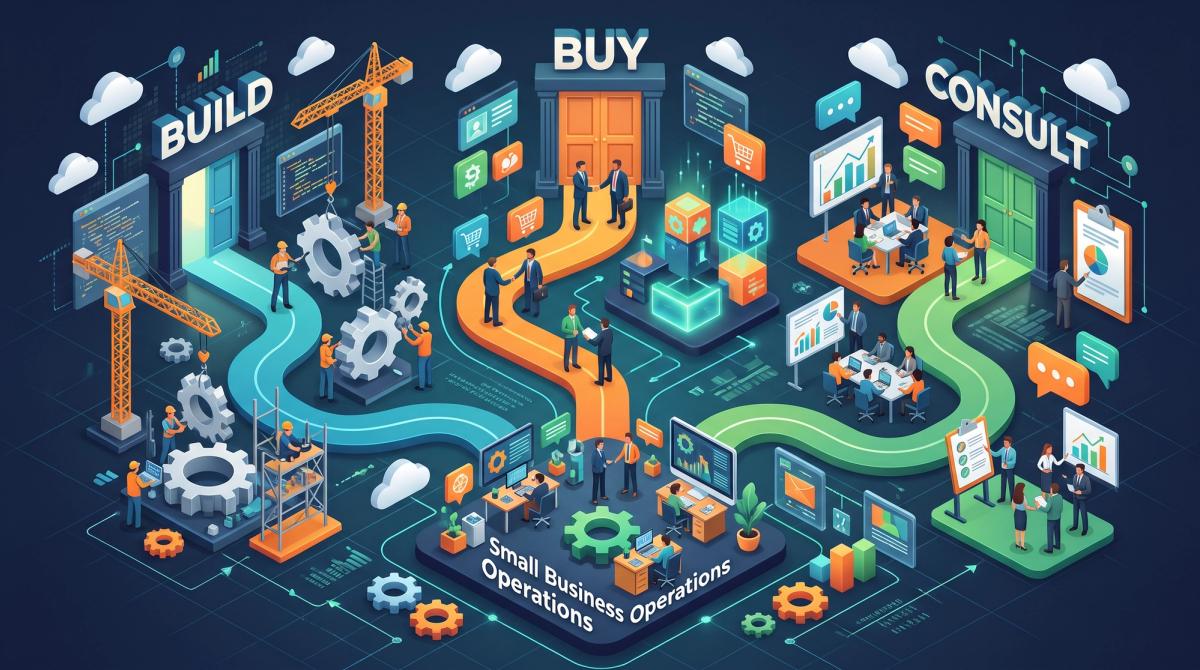
Every growing business eventually hits the same wall. The spreadsheets and off-the-shelf tools that worked at ten employees start breaking at fifty. That’s usually when owners start looking into software consulting for small business, and it’s also when three very different paths open up: build something custom, buy an existing product, or bring in outside help to figure out which one makes sense.
None of these is automatically the right choice. Each one trades cost against control and speed against fit. The most common mistake is picking a path before understanding those tradeoffs at all.
The Three Paths: Build, Buy, or Bring in Outside Help
Buying means subscribing to existing software, such as a CRM, an accounting platform, or an industry-specific tool that already handles most of what you need. Building means paying a developer or team to create something from scratch, shaped around your exact process. Hiring a consultant sits between the two. You pay an expert to assess your situation, recommend the right path, and often carry it out, whether that means setting up a purchased tool or scoping a custom build.
Most small businesses default to buying because it’s fast and cheap upfront. More often than not, that’s the right call. It isn’t the right call every time, though, and knowing the difference saves real money down the line.
When Buying Off-the-Shelf Software Works Best
If your process looks like most others in your industry, someone has probably already built a tool for it. Standard accounting, basic scheduling, and common CRM workflows are solved problems. When you pay a monthly subscription for a tool thousands of other companies use, someone else handles the updates, security patches, and bug fixes.
The tradeoff is fit. Off-the-shelf software is built for the average customer, not for your specific workflow, so your team ends up adjusting to the software instead of the other way around. For a lot of businesses, that’s a fine trade. For others, it creates friction that never quite goes away.
When Building Custom Software Makes Sense
A custom build makes sense when your process is truly different, when no existing tool covers the gap, or when you’re stitching three or four disconnected tools together with manual work in between. If your team spends hours a week copying data between systems or working around a tool’s limits, a custom fix will often pay for itself.
The catch is cost and time. A custom build is a real project with a real budget and timeline, and it only pays off if the problem is big enough and lasting enough to justify the investment. Building custom software for a problem you might outgrow in a year rarely makes sense.
When Software Consulting Is the Right Call
This is where outside help earns its keep. Most owners aren’t set up to compare a dozen CRM platforms, estimate what a custom build should cost, or spot which parts of their workflow can be automated. A software consultant helps answer those questions before any money goes into a build or a subscription.
A good consultant will also tell you when you don’t need them and when the right answer is a $30-a-month tool rather than a custom platform. That advice is worth paying for even when it doesn’t lead to a big project.
Signs It’s Time to Bring in a Consultant
- You’re comparing more than three software options and can’t tell which one fits your actual workflow.
- Your team relies on workarounds like spreadsheets, manual data entry, or copy-pasting between tools.s
- A previous software purchase didn’t solve the problem you bought it for
- You suspect automation could save hours a week but don’t know where to start
- You’re about to sign a multi-year contract for a tool you haven’t fully tested against your process
How to Choose Between Build, Buy, and Consulting
Start with the size of the problem. If it costs you a few hours a month, buy something off the shelf and move on. If it costs you dozens of hours a month, or it’s limiting how much the business can grow, get an outside opinion before you commit to buying or building.
Ask for a fixed scope and a fixed price before you agree to any consulting engagement or custom build. Open-ended hourly billing for a vague project is how small businesses end up with half-finished software and no clear return on their investment.
The right software decision matches the size of your problem. Sometimes that’s the cheapest option, sometimes it’s a custom build, and often it’s somewhere in between.
Getting Help With Your Software Decision
If you’re looking at a stack of software options and can’t tell whether to buy, build, or bring in help, that uncertainty is normal. It’s exactly the gap a software consultant is there to close. At Resilio Partners, we build fixed-price platforms and automation for businesses that need custom work. Often, though, the right answer for a client is a smaller fix or an existing tool set up correctly. Either way, you walk away with a decision backed by a clear scope and a clear price, not a strategy deck.
FAQ
What does a software consultant do for a small business?
A software consultant reviews how your business runs, finds where your current tools fall short, and recommends whether to buy existing software, build something custom, or adjust what you already have. Many consultants can also carry out the recommendation, from setting up a tool to managing a custom build.
Should a small business build or buy software?
Most small businesses should buy first, especially when their process resembles that of others in their industry. Building makes more sense when no existing tool fits, when your team relies on heavy manual workarounds, or when the problem is large and long-term enough to justify the investment.
When is it worth hiring a software consultant?
It’s worth considering when you’re stuck between several software options, when your team depends on spreadsheets and copy-pasting to keep things running, when a past software purchase didn’t solve the problem, or before you sign a multi-year software contract.
How much does software consulting cost for a small business?
Costs vary by scope. To keep your budget predictable, ask for a fixed scope and price up front rather than open-ended hourly billing. That way, you know exactly what you’re paying for before the work starts.
Can a consultant recommend off-the-shelf software instead of a custom build?
Yes. A good consultant should recommend whatever best fits your problem, and sometimes that’s an inexpensive, existing tool set up correctly rather than a custom platform.
What’s the biggest mistake small businesses make with software decisions?
Choosing a path before understanding the tradeoffs. Buying, building, and consulting each balance cost, speed, control, and fit differently, and matching the choice to the size of your actual problem is what keeps you from overspending.
AI Transparency: This article was drafted with the assistance of AI and reviewed, edited, and shaped by the author’s own opinions and experience.